Showing posts with label Apert Syndrome. Show all posts

Monday, November 30, 2020

Keep Our Programs Off The Chopping Block


Today is Giving Tuesday, a global day of giving to nonprofits like Children's Craniofacial Association. On this day we encourage you to give to CCA to help us continue our programs -- financial assistance, Annual Family Retreat, and distribution of free curriculum and outreach to students in classrooms across the country that bring this curriculum to life. Will you help families like the Watts find community and access to care? We hope after reading their words you will consider CCA for your #GivingTuesday donation today. 


"The children that are a part of CCA have a strength and resilience about them that many adults cannot duplicate. It is from them and Jordan, where we gain our strength. Multiple surgeries, appointments, therapies, scans, bloodwork, I could go on for hours, but our children rarely complain. They understand it is part of their journey and we need to make the best of it. Sometimes that means video games at the hospital, other times it is the joy that is our CCA retreats.

Emma was born on July 2, 2018, at 36 weeks in Seminole, TX. She was brought to the NICU due to having Apert Syndrome. Apert Syndrome causes craniosynostosis which is the early fusing of the sutures in the skull, the fusing of fingers and toes, protruding eyes, and a pushed in midface. Emma’s midface was pushed in quite a bit and she was bagged for 5 hours in Seminole until the UMC transport team was able to come and get her. They got her intubated and took her via ambulance to UMC where she was placed on a ventilator until she was able to breathe on her own 2 weeks later.

Our first experience with CCA was when Emma was 4 months old and had to have emergency surgery due to a cerebrospinal fluid leak. I did some research and found CCA online. I contacted Annie and she sent me the application for assistance and the instructions on how to return it. At the time we had depleted our savings and were struggling to pay for food, gas, and hotel during our stay in Lubbock, TX. Emma’s medical team is two hours away, so when there is an emergency it takes a lot for us to go back and forth two hours daily. CCA reimbursed us on a majority of our expenses that we struggled to pay during this time.We were so thankful and so grateful for this. It was amazing to have an organization that was willing to help us. When you’re going through these situations, this support means more than I can put into words."


How has CCA given your family hope and strength this year?

"CCA has since assisted us with multiple trips to Sacramento, CA, where Emma had to have two syndactyly release surgeries. My husband and son (whom we did not have childcare for) would not have been able to come to assist me without the assistance of CCA. Emma has a tracheostomy and g-tube and we have to carry a lot of medical equipment with us during travel. This, plus a car seat and luggage, would have been impossible for me to do by myself, and driving to Sacramento from our home in Hobbs, NM, was a 34-hour drive. Thanks to CCA I was able to have the help from my husband that I needed to make the trips. CCA and Annie have been a giant blessing in our lives. Their assistance is so important to families like ours!"

Watt Family
Hobbs, NM
 
Donate today to our month-long #GivingTuesday fundraiser filled with gratitude. 

As a special incentive, every gift $100 or more at this link https://tinyurl.com/y35ns7vnlink will receive a customized, reusable CCA Starbucks Cup, which makes a perfect gift! 

Give NOW through midnight (12:00am PST) on Dec. 1, and we'll be sure to mail every $100+ donation a heartfelt incentive.


Thursday, August 29, 2019

Almost Famous: Being Recognizable As A Person With A Facial Difference by Jenna Ottow


By Jenna Ottow

Sometimes, having a facial difference can be completely unnerving, frustrating, and tragically lonely.  I don’t believe anyone who appears physically normal will never really know what this feels like or even understand just how alienating it is.  One example of how this manifests itself in real time is by being what I call “almost famous.” In other words, everyone seems to recognize you, even when you do not recognize them.

Unfortunately, for you dear reader, this article isn't about the coming-of-age film from the early 2000’s that stars a young Kate Hudson, about the early days of Rolling Stone magazine.  This is about living the life of a person born with a facial difference, of being recognized even when you do not want to, and to be, dare I say, Almost famous, when you least expect it or want it.
I can’t really do anything about this so-called fame because I was born with a facial difference, Apert syndrome. Apert syndrome is a craniofacial condition characterized by fused skull and skeletal bones, hands, and feet. People born with Apert syndrome need to have skull surgeries shortly after birth to allow the brain and head to grow, resulting in differences in the appearance of the head and face.

So now that you know the basics about Apert syndrome, let me explain how this almost fame manifests.
I have a very small role in a very big hospital.  I have very little to do with the split-second decisions that medical staff make actions that ripple and change the trajectory of people's lives and worlds.  However, in my role here, and in other spheres of my life, everyone always seems to know me, to remember me.  We, most often times, have never been formally introduced to my knowledge, but they always know me by my name.   Admittedly, I have an infectious optimism, and I can’t help but be funny and nice to everyone – sometimes to a fault. But I’ve come to realize that’s not why they know me. They know me because I look different, because no one else here has a facial difference. I know, I’ve looked!  There’s no oversized foreheads, wide set eyes, different hands, or arms that can’t reach above the shoulders.  

 What a bummer! I thought they found me memorable because of my sparkling wit and work ethic!  My appearance, the way I was born, sadly, makes me hard to ignore. The fingers that don’t bend, the ‘flat face’ that doesn’t look quite right.  

I was born this way.  My birth defect makes me stand out, holds extra stares and comes with an encyclopedic knowledge of medical terms and procedures that I wish I didn’t know, or experience.  With a physical difference, I'm remembered. People even tell me so.  Friends are in awe when strangers know my name.  My family can't believe when I'm recognized at restaurants, the movie theatre, or even random public events when people stop me to say “Hello.”   I'm polite when I don't know them, I look for subtle hints to try to place them so I can once again have some power in the midst of this uncomfortable encounter.  This tactic helps some, but not always. Sometimes I have to pretend like I remember this stranger’s face which is always awkward because I don’t love lying. Ultimately, I am striving to make this brief meet- and- greet far less intimidating for me, as they are likely oblivious.  It’s embarrassing to have to ask their names or to deftly avoid using names altogether. They know me, they’ve gone out of their way to tell me so, and now it might just hurt a little because I don’t know them. 

My parents did a phenomenal job when I was younger of making me a part of everything. Mainstreaming kept me in some state of ignorant bliss..  I tied my shoes with everyone else, gushed over the cutest boy toy (I’m looking at you Hanson brothers and JTT!) and fed into the latest fads and trends.  I was convinced my eternal optimism and upbeat personality were what made the encounters stick.  As well as their intentions were, my parents did me a great disservice. I lived in this bubble and as joyous as it was, it is now completely unsettling. I can’t blame them.  You can’t tell a 6-year old that their difference is going to make them the person that everyone knows. A statement like that would be overwhelming and cause some tears. You can’t tell your child that this life they live with 8 fingers and toes is not the norm.  That the girls will whisper and the boys will hide.  All off this information, if imparted to me by my parents would have shaken my soul.  It would have broken me. It likely would have changed the trajectory of my life. I would not be the happy person I am today if I had known more about my difference when I was younger. In some weird way, I am forever glad that my parents mainstreamed me. Fast forward to today, and the reality of being easily recognizable always feels like a crushing, surprise blow to my ego.  

Growing up not only were my parents trying to encourage that I appeared normal, but I was striving for the same thing, too.  In fact I even pretended 'IT’ (my physical difference) wasn't there.   But now that I'm an adult, I can’t. I know now that I'm different and it's obvious.  It disqualifies me from sitting in exit rows on the airplane, overlooked for dates, desired positions and promotions at work, and even missed social opportunities.  I can’t bring it up because then it becomes about me, the attention fiend looking for preferential treatment, making things awkward, wanting to get noticed when all I want to do is hide or blend in.  It’s ironic.  I have to wait until it is pointed out.  Then I must be am prepared to address it.  

I'm getting better at being noticed. I introduce myself when I get addressed by name at the coffee maker at work.  It backfires sometimes.  One woman politely pointed out that I’ve introduced myself to her three times.  Oh well! So much for being polite. 

 What surprises me most of all is that the handful of people that I’ve spoken to about this revelation of easy recognition, some with physical differences, but others whom would be considered  ‘normal bodied’, completely understood where I was coming from.  They get that this phenomenon of someone knowing you, but you not knowing them is, well, for want of a better term, strange. 

We can’t pretend that my facial difference isn’t there staring you in the face, literally. I see what you see and I even know what you might think. I hate that it's uncomfortable, but it is what it is.  We are both accomplices to this a social faux pas. Physical difference should be celebrated.  We must ask ourselves, how can we change the narrative? Can we use mind control to make the world a kinder place? Because I wish we could.  No, I think we need to educate more people around the world about facial differences. I am so happy we celebrate Craniofacial Acceptance Month each September. Hopefully, this annual acceptance month, dedicated to those of us with facial differences will raise awareness about issues like being easily recognized for something we did not choose, a facial difference due to a genetic condition. 

I'd be more comfortable, you’d be more comfortable, and maybe, just maybe, the world would be too.  

Until then, I’ll see you at the coffee maker or at the train station. Do forgive me if I forget your name.


Wednesday, July 17, 2019

#ThankfulThursday: Dougans Raise and Donate Funds From Pop-Up Fundraiser

L-R: Kara Jackman, Marketing and Communications Coordinator, Brisa Dougan, Conley Smith, Bethany Dougan, Erica Mossholder, CCA Executive Director, and Khadija Moten, Outreach Director


Conley Smith and Bethany Dougan from Bonham, Texas donated $146.13 after hosting a pop-up fundraiser for CCA in honor of Brisa Dougan. These budding entrepreneurs sold hot chocolate and cookies to guests at a local boutique during a rare, chilly, spring day in Texas.  The funds raised will go to CCA Kids in need of travel assistance to access quality medical care, distribution of educational curriculum, and social support and networking.

Thank you Conley, Bethany, and Brisa for donating to CCA Kids. You were a breathe of fresh air during a hot day at the office in June. We enjoyed talking to you about your softball tournaments and our #ChooseKind library. 

Keep up your fundraising ways, so you can keep changing the world. 

Monday, June 10, 2019

Dillon Reflects Poetically About His Brother and Best Friend


Credit: Eric Lucas Facebook Page


By Dillon Lucas

Editor's Note: Seventeen-year old Dillon Lucas wrote this poetic reflection about his brother, and best friend, Brody. Brody was born with Apert syndrome. Dillon has watched his younger brother manage and overcome many surgeries. In this piece, he reflects on what the parental and sibling experience mean to him. He shows us the effect it has had on his family and himself through descriptive imagery and rhyme. Thank you for your thoughtful poem, Dillon. Writing is a beautiful way to honor our feelings, families, and personal experiences. You have captured them well. Keep on writing! Continue to share your spirit with the world.

My Best Friend

We have put him in the arms of a surgeon.
We have slept upright in a hospital chair.
We have listened to the beeping of machines.

We’ve been thankful.
We’ve smiled through the tears.
But with all of this going on all we can feel is fear.

We aren’t able to do anything when the time comes.
All we can do is sit there, hope and pray
That hopefully he will come out of that room one day.

The doctors, about to take him in the room.
I turn to my mom and she sheds a tear.
She leans to him and whispers “My sweet boy there is nothing to fear”

I hold back the tears after looking at my mother.
All I can do is wonder.
On what those surgeons will be doing to my little brother.

Saturday, June 8, 2019

Hannah's A Success!


Editor's Note: As we celebrate Apert syndrome awareness month, we thought some stories were in order. Meet Hannah Brown from Fox River Grove, Illinois. She loves going to Myrtle Beach, SC on vacation, kayaking, and shopping. In this reflection she tells us what her life is like with a person that has Apert syndrome.

Thank you, Hannah for helping us raise awareness this month.

By Hannah Brown
Having a Craniofacial difference means facing hard challenges, I was born with Apert Syndrome. which means all my bones were fused together. Sure, I may look different on the outside, but on the inside I sound and act like a normal person. Even though I have limitations, I can pretty much do normal things like everyone else.
I had to deal with name calling, teasing, pointing, constant staring when I was younger because of my facial difference. Now that I'm getting older I still get the stares, but thankfully not so much the pointing or teasing.
In November 2017, I flew solo for the first time. It was awesome. Back when I had the trach, I was always scared of flying by myself with it, but not now. Since 2017, I have flown four times. I'm becoming a pro at flying.
A few years ago I decided to write a book about my life and the challenges of living with Apert Syndrome. The book describes what I went through all these years. The name of the book is Facing the Challenges of Life with Apert Syndrome. I'm taking a break from writing, but will soon get back into working on it.
Life is full of trials and challenges. I know I'll be living with this for the rest of my life. Nothing will limit me from doing the things I want to do and the things I love.
Living with Apert Syndrome has a lot of risks, but I'm willing to take whatever risks God throws at me because I know I can handle anything. 

Tuesday, May 28, 2019

#WonderWednesday: Christine Clinton Speaks to Pennsylvania Students


Christine Clinton visited Pen Ryn School in Fairless Hills, Pennsylvania. Christine's personal story of her life with Apert syndrome brought the book, "Wonder" to life for over 80 students between the ages of 11 to 14. The middle schoolers asked questions and engaged with Christine about bullying, kindness, and acceptance. The themes of the New York Times bestselling book by R.J. Palacio and Christine's presentation reflected well on the school's mission to nurture, empower, and encourage its students in the pursuit of excellence.

One of the Pen Ryn School's teachers commented on Christine's presentation saying, "Christine shared her story with our students, and encouraged them to be kind and get to know each person for who they are, rather than judging them based on how they look. Everything was great! Christine's story is worth hearing by students and adults of all ages. Building an understanding, and hearing her bravery was inspiring."


Thursday, January 31, 2019

My Superhero: A Mom Reflects On A Child's Strength


Photo Credit: Lauren Sirignano

By Lauren Sirignano

This girl is my superhero. My everything. I think of what she’s endured in 2 1/2 years and I am humbled, proud and brought to tears by her strength.

We are about 2 1/2 months out from another string of surgeries for this beauty. I still find myself asking, why? Why does Althea Rose have to endure so much....

I don’t think I’ll ever have this answer, but what I do know is that she can handle it. It’s not fair, it’s not meant to be fair but Althea has a light and strength in her that I have never seen before.

She is not like anyone else. She is literally a superhero; in every imaginable way. I would not change this girl for anything in the world, I would only take away the pain.

Since Althea was born I have occasionally posted stories about the #choosekindness campaign and the importance of educating your kids to not only be friendly, but to be a friend. The stories I hear through our network are filled with hope, love and kindness, but you also hear some that rock you to your core with dread, sorrow and worry.

We are meeting to discuss Althea’s preschool plans in a couple of weeks and I am so excited for this loving, social butterfly to flourish in school. But if I’m being honest, this may scare me more than her surgeries.

I know Althea, I know her resilience, her strength, her stamina, her soul...however, I don’t know other kids...other parents, what’s being taught in other homes, and when talking about school and Althea, that scares me more than words can convey.

PLEASE teach kindness in your home, challenge your kids to be friends with anyone and to always look beyond what’s “normal” by society standards. Teach kindness now, and never stop teaching it.

Althea is a rockstar and will do well in school, regardless but our village can make it easier by teaching kindness to their littles. Pain comes in many forms, and choosing and teaching kindness over hate will help to eradicate possible pain for kids like Althea. Spread love.

Tuesday, January 15, 2019

#WonderWednesday: Angelica Reflects on "Wonder"ful Experience with Utah Students


By Angelica Garcia 

It was an immense joy to come back to Neil Armstrong Academy in West Valley, Utah to talk to the same fourth and sixth grade classes AFTER they read and have enjoyed watching Wonder ☺️ It was great answering more of their brilliant questions. Questions included were from their letters they had sent after our first session at NAA, addressing the value of individuality and self-worth, both sides of bullying, the variety of craniofacial conditions, and truly making connections amidst huge differences. After this live Q and A session, we were by the door greeting the students as they were kind of going out and there was this darling girl that kind of casually made her way between Marco and me. She was out of the line formation wanting to talk. Basically, it was one of those moments where you instantly sense that out of the blue, they want you to notice them for just a little bit for a vital yet unknown reason. With a genuine heart and motherly instinct, I found myself genuinely sharing with her that she is truly beautiful, she deserves to enjoy her life, and things will be okay. I shared my gut instincts with the teacher and she confirmed that the student needed to hear what I had shared with her. It is also one of those moments where from then on, you’ll want to ask yourself, from time to time, how the student (along with everyone else) is doing. This is my purpose and my life mission. I truly love it ❤️ #lifepurpose #teach #sharegoodness #wonder#apertsyndrome 
#apertsyndromeawareness #ambassadors

Tuesday, January 8, 2019

#WonderWednesday: Jaci Speaks at Yardley, PA Middle School


Thank you Jaci Samhammer for speaking at Charles Bohm Middle School in Yardley, Pennsylvania to a class of 8th graders this past November. The eighth grade teacher contacted CCA to ask for a speaker to visit their classroom after reading the R.J. Palacio book, Wonder. Jaci told her story about living with Apert syndrome. The students in turn asked her many tough questions, but she was able to rise to the occasion and provide great answers. Jaci brought the story of Auggie Pullman to life. Here are some photos from her classroom visit. 

Teachers, scout leaders, and other group leaders can request a CCA speaker by contacting Outreach Director, Khadija Moten at [email protected]


Sunday, November 25, 2018

Hannah Brown in Her Own Words


Editor's Note: Thank you, Hannah for sharing your inspirational 

writing with us. Keep up the great work! 


By Hannah Brown
Having a Craniofacial difference means facing hard challenges, I was born with Apert Syndrome. which means all my bones were fused together. Sure, I may look different on the outside, but on the inside I sound and act like a normal person. Even though I have limitations, I can pretty much do normal things like everyone else.
I had to deal with name calling, teasing, pointing, constant staring when I was younger because of my facial difference. Now that I'm getting older I still get the stares, but thankfully not so much the pointing or teasing.
In November 2017, I flew solo for the first time. It was awesome. Back when I had the trach, I was always scared of flying by myself with it, but not now. Since 2017, I have flown four times. I'm becoming a pro at flying.
A few years ago I decided to write a book about my life and the challenges of living with Apert Syndrome. The book describes what I went through all these years. The name of the book is Facing the Challenges of Life with Apert Syndrome. I'm taking a break from writing, but will soon get back into working on it.
Life is full of trials and challenges. I know I'll be living with this for the rest of my life. Nothing will limit me from doing the things I want to do and the things I love.
Living with Apert Syndrome has a lot of risks, but I'm willing to take whatever risks God throws at me because I know I can handle anything. 

Friday, May 18, 2018

Apert Syndrome Study Participants Needed


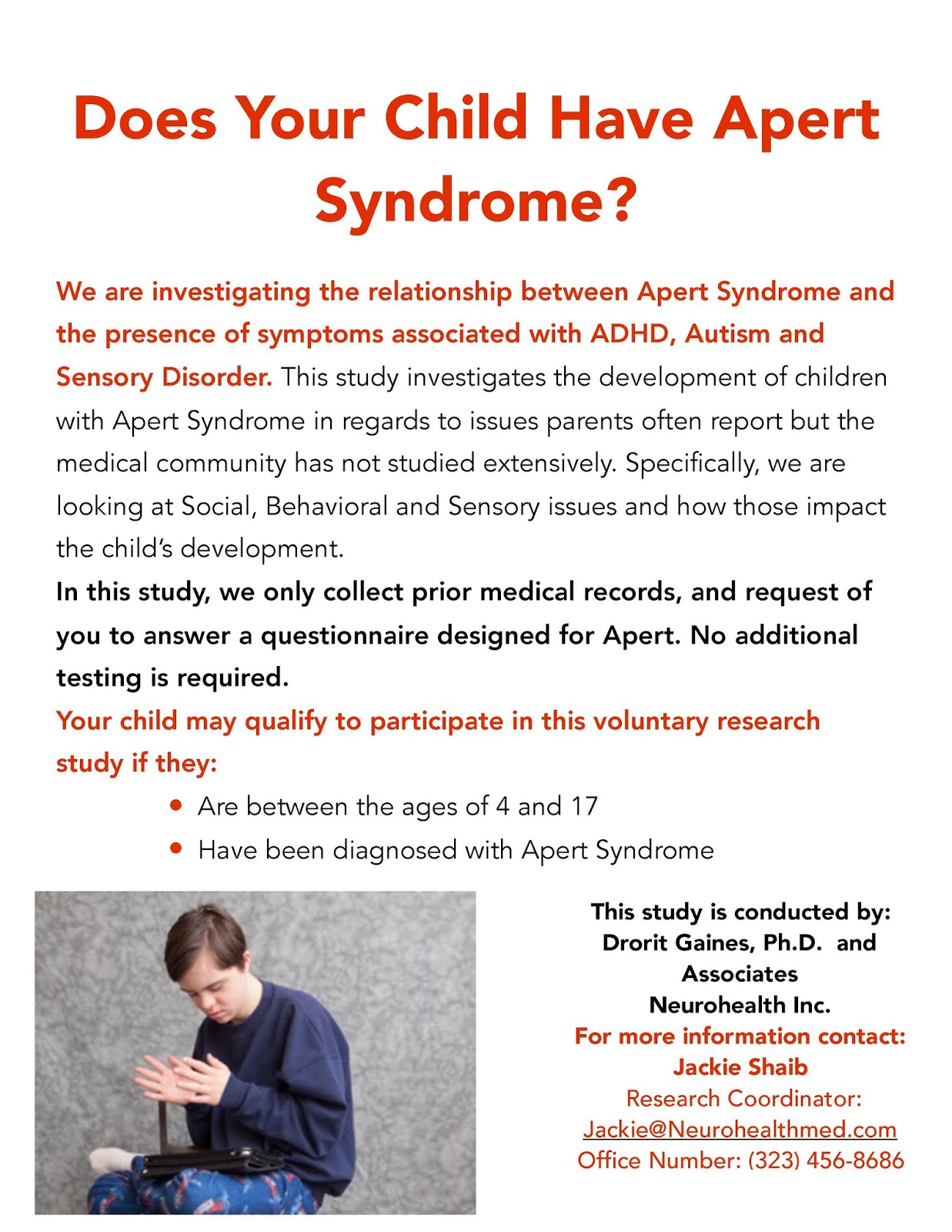
Dr. Drorit Gaines in California is conducting research on the connection between ADHD, Autism and sensory disorders among children born with Apert Syndrome. Please read the flyer below and contact Jackie Shaib, Research Coordinator, if you would like to participate in this significant study that could improve the quality of life for your son or daughter. 

Saturday, March 31, 2018

#NewsDayTuesday: Girl From Ramallah, Palestine Travels to Kentucky for Apert Syndrome-Related Surgeries


A child from Palestine, born with Apert Syndrome, will undergo surgery in Kentucky at Norton Children's Hospital in Louisville. Dr. Ian Mutchnick met Leyan Albazzour while performing neurosurgery overseas in the West Bank. 

Leyan's brain began developing, but her skull did not. She was affected by developmental delays and pain. Dr. Mutchnick could not bear to see her in pain and knew he could help in the form of a cranial vault expansion surgery. 

Learn more about Leyan's experience in Louisville, Kentucky at Norton Children's Hospital in this article. 

Tuesday, February 20, 2018

#NewsDayTuesday: "Wonder" Kindness Challenge Accepted!


Jonathan Siebert is talking to students across the country about the book, "Wonder." Siebert recently spoke with students in South Carolina. Read about his story and how he has helped students understand what is means to be kind.

You can join him by volunteering to speak at a local school or via skype. Contact [email protected] to take the Kindness Challenge. Be part of our "Real Life Auggie Program."

Monday, February 5, 2018

#NewsDayTuesday: Video, Boy with Apert Syndrome Raises Funds With 5K Run


While this event already took place, I think it is a great example of the kind of fundraiser that promotes health, wellness, and awareness about facial differences. Please read Cam's story as covered by a local news station in Winston-Salem, North Carolina. Perhaps come up with your own version of the event to help benefit CCA!

Wednesday, January 17, 2018

Personal Essay: On The Outside

By Jenna Ottow


Jenna Ottow was born with Apert Syndrome, a craniofacial birth defect. She lives in Milwaukee, Wisconsin.  She works in the health insurance field coordinating care and advocating for patients’ needs. She  enjoys hiking with her dog, watching the Green Bay Packers, and reading.  Jenna also enjoys socializing, a good glass of white wine, and any reason to find the silver lining.  

Having a craniofacial difference is hard.  I was born with Apert Syndrome which means I was born with most of the bones in my skull, hands, and feet fused together. These bones are still fused today. A craniofacial difference is on the outside, and it’s obvious. All the time.  Sure it can literally  be masked with sunglasses, scarves, surgeries, or hats. These masks are useful to dodge the second looks, gawks, or whispers, but after those layers come off, the wounds, scars, wide set face (for me) are still there, staring back. Apert Syndrome has followed me my entire life. I am almost always the only  person in the room with a physical difference. I stick out like a sore thumb.  I try not to think about it.  It is confusing, lonely, and unsettling.

I’ve learned from a young age that the stares, whispers, and gawks won’t go away.  Ever.  I realized that in order to survive, to make this life of mine habitable, I needed to change my perspective.  For one of my college scholarships, I wrote an essay on a Nathaniel Hawthorne quotation, "Life is full of marbles and mud."  It was hanging on the wall in the classroom where I was supposed to master the art of cooking.  In the essay, I explained that in order to get through the mud, the focus had to be on the marbles.  Always.  Celebrate the marbles in first class style, own the marbles, that way, when mud rears its ugly head, marbles will always have a place.  A place to look forward to.  That’s all.  A lifetime of experience has taught me to barter the marbles to avoid the mud.

A few years ago after a very filling holiday visiting family, I was boarding an airplane with my parents.  My Dad prefers to sit in the exit row.  At 6’3” his legs get squished in almost all modes of transportation.  The exit row on a 747 has more legroom as it serves as the emergency exit, making a 3 hour flight a little more bearable.  That is where we sat on this flight.  My Dad and I on the ends, my Mom in the middle.  Passengers were getting settled, compartments were opening and closing and the telepathic pleas from the parents to overtired children begging for a “tear-and-drama-free” flight hung in the air. Turns out the children would not be providing the tears that evening.  The three of us had just listened to and agreed with the rehearsed statement from the flight attendant explaining the responsibility that comes with sitting in the exit row.  I believe you have to at least be 15 years old to sit in this row, At the time, I was in my mid twenties.  Phones were getting turned off, and smaller carry ons were being shoved under seats. There was a silence, yet we weren’t moving.  A different flight attendant approached our seats with haste.

She leaned over my seat and said to my parents, "She will have to move.  We’re sorry for any inconvenience, but she can’t be here."

Apparently, a judgement was being made based on my physical appearance that I could not handle the duty of sitting in the exit row, despite my previous confirmations.   My parents, not really sure what their role was in this, looked at me, with my mouth agape as I looked at the attendant.

"You’re talking about me?" I asked her.  The attendant nodded, still looking at my parents. "First of all, I’m right here.  You can look at me, not them.  Secondly, talking around me as if I can’t hear you is unnecessary, and frankly insulting."  I felt disrespected because this flight attendant didn’t think to approach me first.  I was angry, and embarrassed because of the small scene that I had the starring role in.  Furthermore, I was literally paying for this insulting behavior.  I wasn’t even given a chance to defend myself.  I was stunned.  Not wanting to delay the flight and too tired to protest any more, I moved.

 The flight attendant mumbled out a canned apology and showed me my new seat.  Thankfully I had the row to myself, I cried silently to myself almost the entire flight.  I wrote a letter of complaint to the airline, narrating the incident.  A few weeks later the response that came back indicated that the flight attendants had done nothing wrong.    I’m not going to say the flight attendants were wrong in their judgment, it didn’t actually occur to me until right now what would have happened if the airplane had run into trouble.  Again, it was more about how the situation was handled much more than why it happened.  I was not surprised, however to learn that shortly after this incident, the airline went out of business.  Karma.

After this incident, I did a lot of research on the rights of a traveler with a disability.  Thanks to the government, air travel is amazingly accommodating.  Now, when I travel, I utilize the services available, especially when I’m alone. It's less nerve wracking to travel with the government on your side.  One of the biggest, and really the only accommodations that I’m qualified for is being able to board early.  I have limited range of motion because of some residual bone fusion that surgeries never resolved, I can’t raise my arms above my head, coupled with being 5’1” means lifting a carry-on into the overhead compartment is not happening any time soon.  Passengers boarding an aircraft can be chaotic, and my needs for assistance can be inconvenient in the midst of all the bustle.  By boarding early, I’m able to get assistance without being an inconvenience to my fellow flyers, and more importantly, avoid the sea of stares as I find my chosen seat - away from the exit row.

Life is full of marbles and mud, or accommodations and emergency exit rows. Sometimes, using the marbles to avoid the mud makes all the difference.   

Saturday, November 4, 2017

CCA 'Real-Life Auggie' Program Goes International...To Germany!


"Wonder" couple Angie and Marco Garcia, both born with Apert's Syndrome, spoke with students in Germany taking CCA's "Real-Life Auggie" program international. They chatted with Mr. Flores' 4th grade class at Vogelweh Elementary in Kaiserslautern,
Germany for the Department of Defense Education Activity (DoDEA) school system after they read the book "Wonder" by R.J. Palacio. 

Your class or group can host a Skype call with a Real-Life Auggie, too. Contact Annie Reeves about making it happen. 

Wednesday, September 27, 2017

#ThankfulThursday: Many Thanks To Our Doctors


We are thankful today, on this #ThankfulThursday, for our doctors. This post has two videos, one from Children's Hospital Colorado  and the other from the London Craniofacial Unit in the United Kingdom. 

Dr. Gregory Allen clearly states and shows in this video his passion for the work he does for kids with craniofacial conditions, especially cleft lip and palate. Many thanks to the American Cleft Palate-Craniofacial Association for sharing this on their Twitter page. 

Below is the second video from London describing Apert's Syndrome and the impact it has on the child. 


Tuesday, April 4, 2017

CCA Adult Gives Outstanding Speech

We are so proud of our very own, CCA Adult, Christine Clinton.

She had the opportunity to speak at the 7th Annual Winter Gala for The Goryeb Children’s Hospital Craniofacial Center in conjunction with Morristown Medical Center hosted an evening to benefit infants and children born with facial and skull conditions on Thursday, March 23, 2017.

You can see a video of her speech here and photos from the event. We were happy to send our Program Director, Annie Reeves, to the event to support Christine and meet the team in New Jersey, including Dr. Mazzola

Well, done Christine! Check out that standing ovation at the end!

“I think there should be a rule that everyone in the world should get a standing ovation at least once in their lives.”  - Auggie Pullman, Wonder


Thursday, January 12, 2017

Thankful Thursday: Southwestern Community College Helps Staff Member with Apert Syndrome

Occupational Therapy Assistant Program students pictured here with
Casey Deakins (second from right) 


Casey Deakins is very thankful for the help and support she received from the Occupational Therapy students at Southwestern Community College whom made some clever adjustments to everyday office supplies she uses in her work as institutional development assistant. Deakins was born with Apert Syndrome which affects the growth and development of the hands and feet. The adjustments made by these students to these every day object make answering the phone, cutting vegetables, and stapling papers. Her gratitude moved her to throw the group of students a pizza party. The story that appears below was originally posted by Southwestern Community College. 

You can learn more about the school by heading over to their website


When you are around Casey Deakins, SCC’s institutional development assistant, you can’t help but be inspired and smile as she talks about overcoming the obstacles she’s faced in life.

Deakins was born with Apert Syndrome.

“I could be oh woe is me, Scarlett O’Hara over here, but I choose to be positive,” said Deakins. “I love what I do, and I take things as they come.”

Apert Syndrome is a condition that involves abnormal growth of the skull and face that is caused by premature fusion of certain sutures of the skull.

Other anomalies of the syndrome include webbed fingers and toes, as well as wide-set, bulging eyes that are tilted down at the side. Underdevelopment of the jaw usually causes problems with teeth alignment, and some are born with a cleft palate.

Apert Syndrome occurs in one out of every 160,000 to 200,000 births.

When Deakins realized she needed a modified staple remover, she asked Anna Walls, SCC’s occupational therapy assistant (OTA) program coordinator, for assistance.

Walls agreed and asked what else Deakins had difficulty doing.

The OTA students worked together to adapt a staple remover to maximize Deakins’ strength, putting her in the best ergonomic position.

The class then addressed other activities of daily living that Casey identified as difficult, including: answering the phone, cutting with scissors, drinking from a cup with one hand, and using a knife to cut vegetables.

Students worked with Casey on a trial run of various techniques and adaptive devices to increase her independence with the activities she had identified as difficult.

Once appropriate equipment was determined, Walls not only told her where to find the items - but that the OTA student club had paid for the order - telling Deakins Santa had come a little early this year.

“We were so happy to be able to work with Casey. She is such an inspiration to all of us,” said Walls. “Occupational therapy is about engaging people in the activities of life that are meaningful to them. Sometimes we focus on adapting the task by analyzing the skills a person has to use so that they can be independent.”

“We all have really enjoyed working with Casey. She has such a positive outlook and is so sweet,” said OTA student Krystan Inman.

Deakins had one more request of the OTA students and faculty, and that was to eat as much pizza as they could at the surprise party she gave them as a thank you for all they had done.

“It has been fantastic working with the students,” said Deakins. “A simple question I had turned into so much more.”

For more information about Apert Syndrome visit the CCA webpage devoted to this facial difference. 

Monday, December 12, 2016

Ask The Doctor: Can Craniosynostosis be detected prenatally?


By Earl Gage, MD 
Kids Plastic Surgery, Mercy Children’s Hospital – St Louis, MO

Question: Can Craniosynostosis be detected prenatally? I am a 61 year old mom who gave birth to a daughter in 1991 with craniosynostosis and would like to let her know this answer when the time comes for her to get married and start her own family.

Answer:  Thanks for your question. In short, I would say that detection of craniosynostosis by prenatal ultrasound is difficult. This is partially due to the difficulty in getting a “clear look” at the sutures  (or skull expansion joints) when the baby is active and moving in the womb. In addition, prior to birth, the skull bones are not fully developed and have not calcified completely. This can make it more difficult to see the sutures and determine if the bone is fused. In fact, I can think of instances where a newborn child clinically appeared to have craniosynostosis but an early skull xray or ultrasound, obtained by a pediatrician, seemed to show the suture was “open.” In essence, the child had craniosynostosis and a non-functioning suture, but the suture hadn’t calcified sufficiently to make fusion detectable by imaging.  For these reasons, I prefer to rely on a good clinical exam of a newborn infant rather than on ultrasounds or xrays done before birth or even in the first days of life.
While definitive diagnosis of craniosynostosis is difficult prior to birth, there are instances when craniosynostosis is suspected prenatally based on abnormal head shape as detected by ultrasound. For instance, when a child has sagittal synostosis, the skull becomes elongated front-to-back and sometimes tapers posteriorly. This characteristic shape may be seen on ultrasound. Similarly, with some types of syndromic craniosynostosis (eg Pfeiffer syndrome), a markedly abnormal “clover leaf skull” deformity may be present, and this can be detected by ultrasound, too. A diagnosis of craniosynostosis can even be suspected based on the occurrence of other associated abnormalities picked-up on ultrasound, such as fused fingers and toes as seen in Apert syndrome, a condition frequently associated with bicoronal craniosynostosis. However, since abnormal skull shapes due to craniosynostosis are usually mild prenatally (and even at birth) and since head shapes tend to get progressively worse over time, prenatal head shape findings can be subtle and are not always obvious. For this reason, it is most likely that ultrasound detection of abnormal head shape suggestive of craniosynostosis may not be possible until later in pregnancy.
When a diagnosis of craniosynostosis is suspected based on head shape or based on other abnormal findings with the unborn baby, I would encourage the family to meet with a craniofacial surgeon and discuss the possible diagnosis and what may be involved in future care. Ask a lot of questions and do some research before things get really busy with the baby’s arrival. Once the baby arrives, diagnosis of craniosynostosis may just require a physical exam, but additional imaging with a CT scan or MRI may be suggested by your team.