Showing posts with label Pfeiffer Syndrome. Show all posts

Tuesday, May 31, 2022

Are You Dreaming Like Delaney? Because We All Should!


By Kara Jackman

Delaney Cunha is not the average 10-year-old girl. Nope she is above average. Why? Because she took the advice "spread kindness like confetti" to heart. This is her lifelong mission with Drean Like Delaney, a fashion and lifestyle brand (and possibly a book too) that will sweep the nation once she gets a little bit older. Delaney believes everyone should be kind, brave, confident, but most importantly dream big, just like her. In fact, she believes so deeply in this that she has a 15-page business plan to back it up. 

Look out world! Here she comes!


For kids like Delaney with craniofacial conditions school can be a drag. (Not to mention, it gets in the way of executing on your business plan!) Kids are brutally honest and nitpick your every move. Meanwhile there is a lot to learn at school, too. Math, science, writing, reading and history are tough subjects. Add on some additional work in other areas, plus an upcoming very large surgery, and most of us would be overwhelmed. There was little time to execute that business plan or write the forthcoming book from this #WonderKid, but Delaney knew she had to do something to honor this special, scary moment in her life. She had to be brave. 

In spite of some tough questions and comments from her classmates around her extra services, Delaney decided to explain what her craniofacial life is like, and share her message of kindness with them, too. Even after classroom talks with her Mom, CCA Board Member, Kelly Cunha Pokorny, distributions of #ChooseKind gear, the kids continued with remarks. Now in the weeks ahead of her mid-face advancement surgery and three-month recovery with the RED device, Delaney took this as opportunity to really make an impact. She grabbed some fabric markers and large sheets of paper in her favorite colors, and brought them into her classroom, and to nearby schools, businesses and a few hospitals for people to sign in support of her mission and upcoming surgery. The Dream Like Delaney banner tour was on. Banners will visit the following locations, spanning the East Coast, as the Florida-based family travels to Boston Children's Hospital for the big mid-face advancement surgery: Deer Park Elementary, Bayside Sports Academy, St Petersburg Country Club, Moffitt Cancer Center, Johns Hopkins All Children's Hospital, Delta Airlines, and Boston Children's Hospital. 

In support of Delaney, her teachers and resource specialists at Delaney's school encouraged the kids to ask her about her upcoming surgery, write phrases of encouragement and support on the banner. During the summer, kids are encouraged to wear a bracelet in support of Delaney's surgery and 3 month recovery.

Delaney says of her classmates, "I had no idea they supported me until we told them about my surgery, and why I asked them to sign my banner." 

Wristbands will be distributed at all these locations to all Delaney's supporters, too. Hopefully these bracelets will raise awareness about craniofacial conditions and encourage others to ask "how can I dream like Delaney?" 

Further Delaney shares, "I teared up when I realized they really did support me and loved my awareness bracelets."

How can you go wrong with a color combination that are her favorites -- pink, purple, and red swirls? You can find those colors on her hearing aids, and the suitcase she will rock on her trip up the coast. 
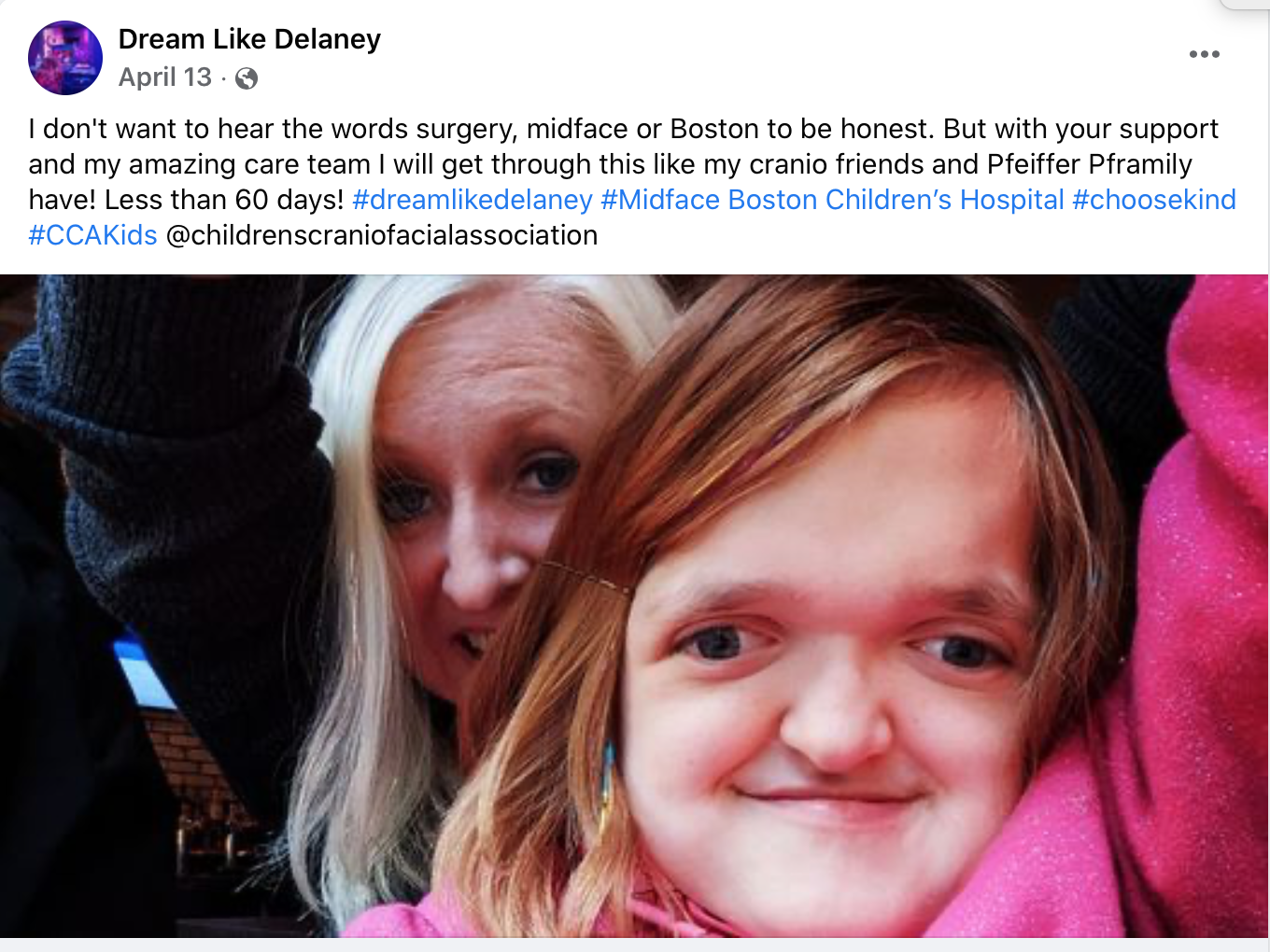

The hope is to gather 200 signatures before the surgery on June 7th. Even if you do not sign the banner, you can join the movement by wearing rainbow colors or pink, purple, and red on June 7th to stand with Delaney. Kelly says, Delaney will most definitely be "brave like all of her cranio besties who have or will overcome the midface." Our support is a big piece to her quick recovery. You can follow "Dream Like Delaney" on Instagram and Facebook

Delaney has grown to love her face, with the support of her immediate family and extended CCA family. Kelly says of her daughter, "She loves skin care, makeup, hair styling and coloring, and vlogging. She enjoys watching beauty influencers like Kylie Jenner. Delaney loves to draw, act, dance, write, and sing, too." 

No one can get this girl down. "No doubt with Delaney's perseverance and strength, one day, we will see Dream Like Delaney become a reality!" shares Kelly. 

And we do not doubt it. Not one bit.  

Never Stop Dreaming.

#dreamlikedelaney


Tuesday, November 26, 2019

30 Stories 30 Faces 30 Years: The Wilsons


Thank you for making our 30th Anniversary celebration truly a year to remember. If that alone wasn’t enough to celebrate, we are now embarking on celebrating the 30th year of our Annual Family Retreat & Educational Symposium in June of 2020! This program is the bones behind our organization and to celebrate it properly we will be bringing the whole crew to Texas, our home state, and the place where it all began!

The Wilson Family of Boaz, Alabama, has so kindly shared with us their journey of navigating their daughter’s facial difference and how CCA’s network and programs have created a strong support community for the entire family. They were a First-Time Retreat Family in 2018, and like many of us, are hooked on the priceless moments and special friendships CCA facilitates with other craniofacial families. Having this special yearly outlet to bring our families together is a critical tenant of our community: togetherness provides strength and connections. This sense of normalcy found at Retreat cannot be replicated or imitated. It is a space created and maintained by the sincerity of our families and the work we do all year long to make it a safe and supportive environment. Read through Laura Wilson’s words on raising their beautiful daughter, Beth, and how becoming a CCA Family has positively affected them:


Hello CCA family!

We are the Wilson family from Boaz, Alabama. Our daughter, Beth, is five years old and our son, Matthew, is two years old.


The first few weeks of Beth’s life have begun to fade into a hazy memory, but somewhere in those weeks is when someone told me about CCA and I sent an email requesting more information about Pfeiffer Syndrome. Someone responded immediately, and even though it took me another few weeks to actually read it, I was thankful to know someone out there cares.

We were, unfortunately, in the percentage of parents that did not know anything was wrong with their child until birth. Not only did we not know, but the words “Cranial Syndrome” might as well have been in a foreign language, because I had no idea how to process what was happening.


Thanks to social media, I was immediately connected with fellow Pfeiffer parents through a private Facebook page. I remember reading all the posts and looking at pictures of smiling kids that were enjoying life despite all the surgeries and obstacles. As Beth grew, it became evident that she was on the more severe side of 
Pfeiffer Syndrome.


In all honesty, it has been an incredibly hard five years for me as her mom. I’ve been through extreme lows. I’m not ashamed to say it has taken therapy and medicine to bring me out of some dark times.

I encourage anyone who is struggling in silence to please see a doctor, because I promise, you can feel normal again. It takes time, but you can do it! I’m a huge advocate for mental health and I’m here if anyone needs to chat.

Now off my personal soapbox and back to Beth… Beth is classified as nonverbal, has yet to be completely weight-bearing and take her first steps. She doesn’t eat anything by mouth and the trach to help her breathe is a love/hate situation.

Each week brings a different experience that tends to make me grieve everything she is unable to do. In those moments I take the time to be sad, sometimes cry, and then look at how happy Beth is. She has an amazing quality of life despite everything that has been thrown her way. I’m proud of how hard she fights to bounce back from major surgeries.

School is her favorite place to be and I’m blown away at how smart she is. Her spunk and sassiness are out of control like any other five-year-old girl. It’s not shocking that she is 100% a “daddy’s girl,” and I wouldn’t have it any other way.

I first heard about CCA’s Retreat right before Beth turned one. I always had intentions of going, but then a surgery would be scheduled, and I would say, “maybe next year we will make it.”

Finally, in the summer of 2018, when Beth was four, and not on anyone’s surgery schedule, we made it to our first CCA Retreat in Salt Lake City!


The first word that comes to mind is “overwhelmed”— but not in a bad way! It was extremely surreal to be sitting in this hotel lobby and see family after family check-in that resembled ours. I had never met another family in Alabama that has a child similar to Beth. The closest family to us, The Shooks, have a daughter with Apert Syndrome but they are over an hour away in Georgia. Huge thanks to The Shooks, because they are the reason we found our amazing Craniofacial surgeon, Dr. Larry Sargent.

During the CCA Retreat, I recognized so many people from social media that I had never met in person until then. It was kind of funny how everyone broke apart into their own groups. I noticed that I bonded the most with parents that also had nonverbal and non-mobile children. We all found our niche within the large crowd of families and it felt comforting.

The CCA Retreat was so well planned and organized, and like most of the kids there, Beth enjoyed the last night, which was full of music and dancing.

As a parent, my favorite was the talent show. Many of the acts left me with tears streaming down my face. These kids are one-of-a-kind and I’m proud to be a part of the CCA Family. Beth will undergo one of her biggest surgeries to-date, mid face, in the summer of 2020, so we won’t make Retreat that year, but you better believe I will be enjoying all of the pictures that will be posted!

Thank you CCA, for all that you do for families like us. You give us moments to look back on that are priceless and friendships that would have never formed if not for your programs.

Feel free to follow our family adventures on the Facebook page, “Beth’s Journey.” We are always up to something new!


The Wilson Family story mirrors so many of our CCA Families’ journeys and we want to continue to support our family network in the years to come! We invite you to commemorate the largest Retreat ever and the 30th Anniversary of our most important program we are able to offer to CCA Families. Without you, this legacy of life-changing work would not be possible.

Please consider a special gift this year to support and amplify our upcoming 30th Annual Family Retreat & Educational Symposium. We want you to help us send as many families as possible to Austin, Texas in 2020! We are expecting over 170 Families. May each of you feel the warmth and love this holiday season you give to each of us at CCA. We thank you for your support of CCA now and in the future. Here is to 30+ more years of empowering and giving hope to individuals and families affected by facial differences!


Sincerely,


Christine Andler

Director of Development

Sunday, June 2, 2019

30 Stories, 30 Faces, 30 Years: Jerry Carchi


CCA has been one of the most inspiring organizations my family and I have ever been a part of. We found a place to call home, when it comes to being a part of group we can count on for advice and a place to pay it forward to a family just starting their journey into the craniofacial world. We have had so many great moments at the CCA Retreats, it is so hard to pick a favorite moment, but I can say that all those moments combine to become one great experience that is filled with pure love, understanding, kindness, and compassion. We see the future of the CCA family growing bigger and stronger as we continue to show families and individuals with facial differences that with love and support we can achieve anything no matter what the world throws at us.

                                                               -Jerry Carchi, CCA Dad


Jerry Carchi is the quintessential CCA Dad from Hohokus, New Jersey. He learned the art of fatherhood from his own great dad, who was always there, selfless, and reveled in seeing his children enjoy life. Jerry says his father “lived for us kids, and set the example of how to be with my child, Sydney.”

Sydney was born with Pfeiffer syndrome in 2009. Jerry and Virginia, her mom, hope to never let anything get in the way of Sydney doing and experiencing everything life has to offer. Jerry says, “CCA has helped Sydney embrace her differences and to never let barriers get in her way.”

The Annual Retreat and Educational symposium has had a positive effect on Jerry’s ability to be a father. Jerry and his wife, Virginia, learned about CCA and the retreat from Diana Sweeney at Children’s Hospital of Philadelphia. Jerry says the retreats have an overwhelming safe feeling. “We were not worried about who Sydney was hanging out with. There was no anticipation of what others were going to ask her. We, as a family, were free to be ourselves and feel a sense of normalcy.”

In addition to their annual retreat adventures, the Carchis love to seek out local adventures. They enjoy going to the park, art exhibitions, musical performances, hoping to show their daughter the world of ways she can authentically connect with people through the things you do, not the way you look.

Jerry has danced his way into our hearts here at CCA and at the Wyckoff YMCA where he works as Assistant Director. Jerry wanted to make a difference and help people find community through his unparalleled dance steps, kind heart, and loving spirit. With that said, it should be no surprise that Jerry teaches weekly Zumba classes at the YMCA and on Saturday morning at this year’s Annual Retreat and Educational Symposium, two communities he cares for deeply.

Monday, April 29, 2019

30 Stories 30 Faces 30 Years: Avery and Carson Cooper


(Editor's Note: Avery and Carson Cooper were featured in a recent E-News. We publish their words here for our 30 Stories, 30 Faces, 30 Years celebration so that everyone can read about their bond and fundraising impact. To get the E-News delivered directly to your email, sign up at the bottom of our website with your name and email address.)


"Friendship with someone who 'gets it.' Honey Badger has many local friends, but loves her CCA friends, who've walked a similar path." 
 

 --Stephanie Cooper, Mom to Avery "Honey Badger" Cooper and Carson Cooper


Sibling duo, Avery and Carson Cooper, are a force to be reckoned with. Their connection is special and they spread kindness along with their family to all of West Michigan, across the USA, and to all their CCA friends. They are also incredibly successful and generous fundraisers, supporting the CCA Retreat and financial assistance program for families on medical travel. Just last year they netted over $5,000 for CCA! They are continually doing service projects and working hard to make the world a better place... not just for CCA, but for the many organizations they support! We are so proud of them! That's why we're happy to feature Avery - nicknamed "Honey Badger," who has Pfeiffer syndrome - and her SuperSib, Carson in our 30 Stories, 30 Faces, 30 Years series.

Tuesday, February 19, 2019

Helen Webb-Prosser Shares Her Wonder Story at Maine Church

Editor's Note: I just loved this Wonder Wednesday story shared with us by Amy Webb-Prosser of Maine. She writes about her wife, Helen, presenting at their local church, West Scarborough United Methodist Church. Amy shares about the pride in her committed, Methodist congregation that is truly living the Methodist slogan of open hearts, open minds, open doors in everything they do. So without further ado...here is Amy's reflection about Helen's "Wonder" presentation. 


The event was held at West Scarborough United Methodist Church on Route 1 in Scarborough, Maine (where I am music director.) It evolved from a conversation Helen had at coffee hour with a group of women from the church about her experiences and the book "Wonder." A few of the women then ordered the book and read it, and suggested that she share her story with the church. So the Worship and Arts committee sponsored a showing of the movie Wonder last Saturday, January 12th, at 1PM in the sanctuary of the church, followed by a presentation by Helen, with questions afterwards. Helen had done the same presentation for the middle school where she works in coordination with their Wonder unit. 


There were about twenty people in attendance. Helen’s presentation was called My Wonder Story—talking about what it was like growing up with Pfeiffer Syndrome, and how it was similar to Auggie’s story. She also talked about how people with physical differences prefer to be approached, which fits in with West Scarborough UMC’s mission to become a more welcoming congregation.

It was very well received, and I actually had someone come up to me and tell me that they thought the congregation would be more comfortable asking Helen about her differences and experiences thanks to the presentation.


Monday, January 7, 2019

30 Stories 30 Faces 30 Years: Zoya Bobov


Meet Zoya our beautiful granddaughter. As Nana, I’ve watched this family meet every health challenge head on. Pfeiffer syndrome certainly has been on the forefront, but definitely does not define our warrior princess. It’s something she has and will manage her whole life, but Zoya is Zoya. She’s strong, fun, loves her big brother and loves to play. Her giggle lights me up every time. We are blessed.”     -Sandy Powers, Grandmother to Zoya Bobov


Zoya and some of her favorite books!
Zoya Bobov is an adorable 16-month-old girl that lives with her parents, Desirae and Vladmir, and older brother Ivan (3 years old) in Seattle, Washington. Zoya was born with Pfeiffer syndrome in August 2017. Her mother, grandmother, and father all agree that she is a “happy little girl” that always has a smile on her face. The Bobov’s say they love exploring nature and are a “super outdoors family!” Most recently the family hiked up Mt. Rainier to celebrate New Year’s Day. Zoya loved the snow! When Zoya finds herself back indoors, she loves spending quality time with her older brother, Ivan, to read books, and scoot around on the floor to prepare for her next outdoor adventure.


Desirae and Zoya on a New Year's Day hike


We love featuring Zoya after her Nana wrote us this submission to our 30 Stories, 30 Faces, 30 Years celebration. Thank you, Zoya, for being one of CCA’s newest stories!

L-R Zoya, Vladimir, Ivan

Monday, September 3, 2018

Meet the McGowans: Tom, Melissa, Abigail, Theresa & Josephine

Meet The McGowans: 


The McGowan clan lives in Canonsburg, PA, which is just south of Pittsburgh (Let’s go Bucs, Steelers, & Pens!). Tom works in the pharmaceutical industry, and Melissa is a teacher/grant writer turned stay-at-home mom. Let’s be honest, though. You don’t want to hear about them, so let’s talk about the kids (who keep them very busy…and tired).

Abigail (Abby) is five years old and was born with Pfeiffer syndrome, but she sure hasn’t let it define her. She is thriving in kindergarten and is currently involved in swimming and soccer. She also enjoys playing at the park, drawing pictures, reading, playing games, having dance parties, and playing pretend with her sisters. She also feels it is very important that people know her favorite color is orange and her favorite princess is Ariel. She says she wants to be a doctor when she grows up, and her craniofacial team has strongly encouraged her in this goal. This November marked a big milestone for Abby: one-year, surgery free!
L-R Reese, Josephine, and Abigail

Theresa (Reese) is three years old and attends preschool three days a week. Reese is involved in swimming and soccer as well, and she enjoys coloring pictures, running outside, playing with dolls, watching movies, and playing with the camera on Mommy’s phone. Her favorite color is “lellow” and her favorite princess is “Belle and Cindelella.” When she grows up, she wants to be a mommy and a teacher…but her biggest goal is to figure out how to spend as much time as possible playing on the iPad.

Josephine (Josie) is 18 months old and stays at home full-time with Mommy. She thinks she’s older and bigger than she really is, but she does a pretty good job keeping up with the big kids. Josie loves to read books, cuddle, play at the park, and copy her sisters. She also enjoys Family Swim at her sisters’ swim school, and she is quickly showing us that she is the fish in the bunch. Every time she goes underwater, she comes up smiling and wanting to jump back in again (and again, and again, and again…). She doesn’t have a favorite color or princess yet, but she does have a favorite accessory: hairbows. She pats the top of her head and fusses each morning until she gets a bow in her hair. What a little diva.

Last year, the McGowans worked together to hold a Wonder advanced screening. It was a WONDErful evening spent raising awareness of craniofacial differences, telling others about CCA, and enjoying the movie.

Read more about Abby's journey on Children's Pittsburgh blog. This entry was written by Melissa McGowan, Abby's mom. 

Monday, December 12, 2016

Ask The Doctor: Can Craniosynostosis be detected prenatally?


By Earl Gage, MD 
Kids Plastic Surgery, Mercy Children’s Hospital – St Louis, MO

Question: Can Craniosynostosis be detected prenatally? I am a 61 year old mom who gave birth to a daughter in 1991 with craniosynostosis and would like to let her know this answer when the time comes for her to get married and start her own family.

Answer:  Thanks for your question. In short, I would say that detection of craniosynostosis by prenatal ultrasound is difficult. This is partially due to the difficulty in getting a “clear look” at the sutures  (or skull expansion joints) when the baby is active and moving in the womb. In addition, prior to birth, the skull bones are not fully developed and have not calcified completely. This can make it more difficult to see the sutures and determine if the bone is fused. In fact, I can think of instances where a newborn child clinically appeared to have craniosynostosis but an early skull xray or ultrasound, obtained by a pediatrician, seemed to show the suture was “open.” In essence, the child had craniosynostosis and a non-functioning suture, but the suture hadn’t calcified sufficiently to make fusion detectable by imaging.  For these reasons, I prefer to rely on a good clinical exam of a newborn infant rather than on ultrasounds or xrays done before birth or even in the first days of life.
While definitive diagnosis of craniosynostosis is difficult prior to birth, there are instances when craniosynostosis is suspected prenatally based on abnormal head shape as detected by ultrasound. For instance, when a child has sagittal synostosis, the skull becomes elongated front-to-back and sometimes tapers posteriorly. This characteristic shape may be seen on ultrasound. Similarly, with some types of syndromic craniosynostosis (eg Pfeiffer syndrome), a markedly abnormal “clover leaf skull” deformity may be present, and this can be detected by ultrasound, too. A diagnosis of craniosynostosis can even be suspected based on the occurrence of other associated abnormalities picked-up on ultrasound, such as fused fingers and toes as seen in Apert syndrome, a condition frequently associated with bicoronal craniosynostosis. However, since abnormal skull shapes due to craniosynostosis are usually mild prenatally (and even at birth) and since head shapes tend to get progressively worse over time, prenatal head shape findings can be subtle and are not always obvious. For this reason, it is most likely that ultrasound detection of abnormal head shape suggestive of craniosynostosis may not be possible until later in pregnancy.
When a diagnosis of craniosynostosis is suspected based on head shape or based on other abnormal findings with the unborn baby, I would encourage the family to meet with a craniofacial surgeon and discuss the possible diagnosis and what may be involved in future care. Ask a lot of questions and do some research before things get really busy with the baby’s arrival. Once the baby arrives, diagnosis of craniosynostosis may just require a physical exam, but additional imaging with a CT scan or MRI may be suggested by your team.

Monday, September 19, 2016

Media Monday: How Do You Approach A Child With A Craniofacial Difference


In August to kick of awareness of Craniofacial Awareness MonthDorina Watkins and Shawna Sanders with their children, Jordan and Sophia, appeared on KESQ's local news broadcast. KESQ is located in Palm Springs, California. 


Jordan, age 6, has Crouzon Syndrome and Sophia, age 5, has Pfeiffer Syndrome. Watch and read more about Jordan and Sophia's experiences at the link below. Thanks so much to Brooke Beare and KESQ for covering this story! 


Saturday, July 30, 2016

Ask the Doctor: Why do you leave distraction device on so long?

CCA posts a monthly blog series called, "Ask the Doctor." You can submit your questions to Annie Reeves ([email protected]) and we will ask Dr. Earl Gage of Kids' Plastic Surgery in St. Louis to answer them. Thanks Dr. Gage for helping spread information and resources for our cranio families!

Ask the Doctor

Earl Gage, MD, Kids Plastic Surgery, MercyChildren’s Hospital
Ask The Doctor
Earl Gage, MD
Kids Plastic Surgery, Mercy Children’s Hospital – St Louis, MO

Question: My five year son had his frontal advancement procedure done one month ago. The doctor told us that it would take about two months for the halo to complete the process. Last week the doctor then made the decision to remove the halo because some of the hardware had loosened, a cord was damaged and one of the sites was getting infected.  He said the advancement was already done anyway. My question is if the halo completes its job when it doesn't need turning anymore why do they leave it on for such of long time?

Answer:  Distraction osteogenesis involves cutting a bone and then slowly lengthening the bone by applying a constant steady force. In order to understand the phases of distraction and why we leave the halo on even after the work of moving the bone is done, it helps to first understand what happens when a bone is broken and needs to heal.

When a bone is fractured, the body begins the healing process by stimulating cartilage and bone producing cells at both ends of the fracture to begin laying down new hyaline cartilage and woven bone in an effort to bridge the fracture gap. This new tissue spanning the fracture is called a callus and is relatively soft. Once the gap is bridged, the callus tissue is eventually replaced with stronger lamellar bone. Additional biologic changes and modifications of the bone occur until complete healing is accomplished. During the process of fracture healing, it is necessary to have good blood supply, good nutrition, good alignment of the fracture edges and good bone immobilization. Fracture healing often takes 4-6 weeks or longer.

Beginning in the early 1900’s some physicians realized that bone could be lengthened applying tension to the bone while in the callus phase of healing. If you lengthen the bone at just the right rate, you can continue to lengthen the bone at the callus while new bone is being formed just behind the callus.  In essence you stay just ahead of where the bone is becoming solid and stretch the soft stuff.

Once you have achieved your bone-lengthening goal, you then stop applying the lengthening force to the bone and instead try to provide stability and immobilization of the fracture so that bone healing catches up and the bone becomes strong. 

The reason, therefore, that there is a period of time after you are done turning the screws is to provide stability to the bones while the bone healing “catches up” and makes the bone solid and strong. This is called the consolidation phase of distraction and may take 4-6 weeks to allow full healing to occur. If the distractor is removed too early, while the bone is still healing and relatively soft, then there is a risk that you could lose some of your gains or that the fracture may not heal appropriately. 

Although we all want to have the distractor in place through consolidation, there are times when the distractor mechanism needs to be removed early. Reasons for early removal can include infection, malfunction or accidental dislodgement. Depending on when this occurs in the process of distraction and consolidation, the surgeon then has to make a judgment whether the bone is sufficiently solid to allow removal or if something else needs to be done to provide stability while the fracture continues to heal. A decision to put a new halo on is a decision based on risks and benefits of another surgery. From what you describe, it sounds as though your surgeon felt that things would be sufficiently stable to allow early removal.


I hope this helps answer your question, and I hope your son recovers well from his surgery.

Saturday, May 2, 2015

Confronting & Resolving: One Approach to Bullying

“It is in the whole process of meeting and solving problems that life has meaning. Problems are the cutting edge that distinguishes between success and failure. Problems call forth our courage and our wisdom; indeed, they create our courage and our wisdom. It is only because of problems that we grow mentally and spiritually. It is through the pain of confronting and resolving problems that we learn.” --M. Scott Peck

Confronting & Resolving: One Approach to Bullying
by Sabrina Robineau 

Junior High is an exciting, yet nerve-wracking time in an adolescent’s life. It’s a whole different world that comes with new opportunities and challenges. However, nothing could have prepared me for the challenge that I was about to face on my first day of Junior High….

First of all, I have to note that I was very fortunate in elementary school. I had many friends and everyone knew who I was. Every time I had surgery, I would receive get-well cards from all the classes. School was my safe place; I was sheltered from the stares and teasing. It was my escape from the discrimination I faced in the outside world.

When I was 12 years old, it came time to enter a new school. I was more excited than nervous because I now had independence. Junior High felt so  'grown up.’ I also still felt safe because some of my friends from elementary school would be there. On the first day, we were assigned to our homeroom. I excitedly looked at my schedule and explored the hallways until I found the classroom. I’ll never forget how it felt when I first walked in. It suddenly became very quiet as all the students stopped talking and turned to look at me. I figured “oh they’re just looking because I’m the last one to walk in.” As I sat at a desk, I noticed that they weren't just looking -- they were actually staring at me. Some students were whispering to each other and snickering. I thought to myself “what is going on here? This has never happened in school before!” – what was once a safe place for me, would soon become a place that I hated.

Not only was I stared at in class, but in the hallways as well. I remember that gnawing feeling I had in my stomach as I passed by the lockers. Students would be whispering, pointing and staring. I tried to ignore it and focus on the friends from my old elementary school. I figured the stares would eventually go away. Unfortunately, it continued on for weeks. Finally, I decided “enough is enough!” couldn't take it anymore. I wanted to feel comfortable at school again. Therefore, I set up a meeting with the guidance counselor. I told her that how desperately I wanted everyone to know that I’m still the same as everyone else, even though I look different. Unsure of what to do, we went to see the principal. She suggested that I go in front of every class and talk about Pfeiffer Syndrome and answer any questions they might have. Some people might ask “Wow, weren't you shy to do that?” – Surprisingly, I wasn't nervous at all. I was so determined to speak up and show everyone the real me. I wanted them to see that there was nothing to be afraid of.

The following day, the principal and I addressed our first class. It was intimidating to face the students, but I kept my head up high and proudly talked about my syndrome and what I’d been through. To my surprise, I got a very pleasant reaction from the students! They were interested in what I had to say and they asked many questions such as, “Does Pfeiffer Syndrome affect your intelligence?” (It does not.) I received the same positive reaction from all the classes. I began to realize that the students were not staring just to be mean … they were only curious. They were faced with the unfamiliar and they didn’t know how to react. They did not have the knowledge to understand why I looked different. 

When I went back to school the next day, my world was completely changed. Instead of getting stares and whispers; I got big smiles and waves, “Hi Sabrina!” – There was no more hesitation or wondering “Why does she look like that?” I made new friends and school became my safe place again.

What would have happened if I never had the courage to speak up? Nothing. Nothing would have changed. I would have continued to be stared at. I would have spent my 2 years at Junior High being miserable. I am so thankful that I had the support of the principal who encouraged me to face the students. Once I educated them about Pfeiffer Syndrome, it was no longer unfamiliar to them. I told the students to never judge a book by its cover because it’s what on the inside that counts!

Wednesday, September 18, 2013

CAM Photos: Sabrina

Blogger Sabrina shows off her new Beyond the Face t-shirt at her university (next to the CAM poster she hung!).

Happy Craniofacial Acceptance Month!

Check out her two most recent blogs here: The Importance of Educating & Grateful Sunday.

Do you need some CCA gear? Order this month and you'll get FREE Priority Mail shipping through September on all BEYOND THE FACE TEES! http://www.promotes.me/

Help us turn the CCAKidsBlog.org YELLOW!
Want to submit a CAM photo? Send in your CAM photos to [email protected]
Your submission is permission to post your photo on the blog. 

Thursday, September 12, 2013

The Importance of Educating

Imagine a world where everyone knows what a craniofacial syndrome is; a world where a child with a craniofacial condition is able to play at the park without getting stared at or bullied. Can you imagine a world where no one is judged for what they look like on the outside? Where everyone is accepted for who they are on the inside? That would be a pretty amazing world, wouldn't it?

This summer I had the pleasure of working in a dining hall for the 2013 Canada Games. The place was filled with athletes. Among these athletes, I noticed one of them had Down syndrome. She was a very sweet girl who always came in with a smile on her face. What I also noticed was that no one stared at her or made rude comments. She just blended in with the crowd. Unfortunately, for me, this was not the case. Throughout each day, I would notice people staring at me as I worked. Even when I talked to some of them, I could tell by the way they were looking at me, that they were trying to make sense of my facial differences.

I began to wonder, why did they stare at me, but not at the other girl too? Suddenly, it dawned on me; familiarity. It is safe to say that a majority of the population is aware of Down syndrome. They teach us about it in elementary school and we also even see people with Down syndrome who are actors in TV shows and movies! This made me realize that the reason the athletes did not stare at that girl, is because they all knew about Down syndrome and so it was no big deal to them. When people are faced with someone that looks unfamiliar and different, it makes them curious and more likely to stare and sometimes even judge.

What I went through at work, got me even more excited for September to arrive. This month means a lot to me because it is our chance to educate others. The more we educate, the more we are able to wipe out ignorance. If we educate others about facial differences, then they’ll be more understanding and hopefully more accepting. Knowledge is power! Every time I meet someone new and tell them I was born with Pfeiffer syndrome, I always get the same response: “Pfeiffer syndrome? I've never heard of that! What is it?” My hope is that one day; people will automatically know and recognize what a craniofacial syndrome is. Therefore, if they see someone that looks different, they'll shrug it off like it's no big deal. How is this possible? By spreading awareness! For the past 2 years during Craniofacial Acceptance Month, I have put up CCA posters all around my university campus. This year was no exception. As I started putting up the posters, I got that feeling of excitement. When I walk to class and see all the yellow everywhere, it makes me proud to be a part of CCA and all that it stands for. I have always believed that we should never judge a book its cover. It's what's on the inside that matters!

Beyond the face is a heart :) 

--Sabrina

Showing off our Awareness Month Poster on Campus

Friday, May 17, 2013

"What's wrong with your eyes?"

Please welcome our first "Guest Blogger", Sabrina!

Hi, my name is Sabrina and I'm 22 years old. I was born with Pfeiffer Syndrome (Type 1) as well as a congenital heart defect. I have had 21 surgeries. I'm currently in University, majoring in Health Psychology with a minor in Political Science. I heard about CCA when I was 15, and attended my first retreat in Nashville, TN. It was an incredible experience!! I loved meeting others who have been through the same things as me. Overall I have gone to 5 retreats and enjoyed every second of it. I highly recommend that every family should make it to at least one retreat. It's an amazing event that you will never forget. It not only benefits the child, but the whole family as well!

We are so happy that she has offered to share her insight on the
CCA Kids Blog and we hope you enjoy this new perspective.


When I went out the other night, I got to meet some new people. After being introduced to one woman, she later asked my mom “is she blind?” My mom was shocked, came to my defence and said “there's nothing wrong with her eyes, she has 20/20 vision!”

Normally, a comment like that would have upset me. However, earlier that night, I was complimented many times on how beautiful I was and how nice my dress was. Those kind words meant a lot to me and really made me feel confident. So when I heard about the woman who asked if I was ‘blind’, it just amazed me how ignorant some people can be. I have gotten many negative comments about my eyes over the years. I had hoped they would stop as I got older, but unfortunately, there will always be people out there who just don’t understand.

Being born with a craniofacial disorder presents many challenges for a child, which will continue on throughout adulthood. Even though it was tough going through so many medical procedures, I always felt that ‘social situations’ were more difficult to deal with. I’m not what society considers “normal” and I felt that judgment at a very young age when I noticed kids and adults staring at me. To be surrounded in a world where outer beauty is portrayed as the most important thing, it’s difficult not to let it get to you.

How do you deal with that? How do you deal with trying to blend in with society, when they always make you feel like you stand out? The key is to find people who will love you and accept you just the way you are. I am so fortunate to have the loving support of my close friends and family. When I feel loved, it is easier not to get upset when I’m judged by strangers. Though, of course, everyone has their ‘bad days’. Sometimes, I do get very agitated. If I’ve already had a long day and I’m tired, the last thing I want to deal with is judgemental stares when I’m out in a public place.

Living in a world that is so fixated on self image and outer beauty, I grew up thinking that I would never truly be accepted for who I am. Naturally, every time I met someone new, I would automatically wonder “do they notice something different about me? Do they think I look weird?” Even nowadays, I try not to over think it, but old habits are hard to break. When I went to my job interview in January, I was actually afraid that they wouldn’t hire me because of the way I look. Of course it may seem crazy to think like that, but when you’ve grown up going through situations where people make fun of you, doubt you, and talk down to you; it messes with your self-esteem.

Dealing with stares and judgement is always hardest when you’re a kid. When I got teased, I felt ‘ugly’. I would dream of having a different face. I wanted to be like the ‘pretty’ girls. I thought that I had to be like everyone else in order to feel accepted. It has been a long and tiring journey, but I am finally at a place now where I am happy with the way that I look. I don’t focus so much on it anymore because it’s what’s on the INSIDE that counts.

Would social situations be easier if I didn’t have Pfeiffer Syndrome? Of course. But this is the card I was dealt and I can’t change that. When you can’t change something, you have to change your attitude about it. In junior high, I was surrounded by new students who constantly stared at me as I’d walk down the halls. Eventually, I got tired of being stared at, so I went to the principal to see if I could do something about it. She suggested that I go in front of every class and talk about Pfeiffer Syndrome. I was afraid of how they’d react, but it turned out to be a success! I could see that they weren’t being mean, they were actually just curious because I got asked many questions. The next day, instead of getting stared at, I got waved at! I made so many new friends and I finally felt comfortable at school.

As much as we’d like to prevent it, there will always be ignorance in the world. I will never be able to ‘blend in’ and not get stared at. (Although I will admit that I sometimes ‘hide’ behind my sunglasses so no one can see my eyes). Instead of getting angry at people who stare and make comments, I just feel sorry for them. When I look in the mirror, I just see “me” and I’m fine with it. I don’t think there’s anything ‘different’ about me, because we are ALL different. On those bad days, I ask my mom “what is so different about my eyes? What do they see??” It does frustrate me sometimes because I can't understand what people see in me since we're all different in our own way.

In my first semester at University, I was eating lunch with a guy that I had just met, who lived in the same residence as me. He said “um, do you mind if I ask you a question? Don’t take this the wrong way but... what’s wrong with your eyes?” My immediate reaction was “well, I was born this way!”, because really, what other explanation is there? I decided not to let that situation bring me down because a part of me knew that he didn’t mean to offend me. He just noticed something ‘different’ and was curious about it. This is where it’s good to spread awareness and to pass on knowledge about craniofacial syndromes.

As life goes on, there will always be times where we have to face a difficult social situation and we may feel uncomfortable at the moment, but we have to get past it and move on. Life is too short to focus on negativity. The important thing is to love and accept yourself, and with that frame of mind, no one can bring you down. I have been working on loving myself and embracing my unique side. I surround myself with people who believe in me and encourage me to follow my dreams. I know I can make a difference in this world. I'm going to graduate from University, and get a job where I can help others. I won't let anyone stop me from accomplishing my goals.


Always remember:
Be who you are and say what you feel because those who mind don't matter and those who matter don't mind” – Dr. Seuss